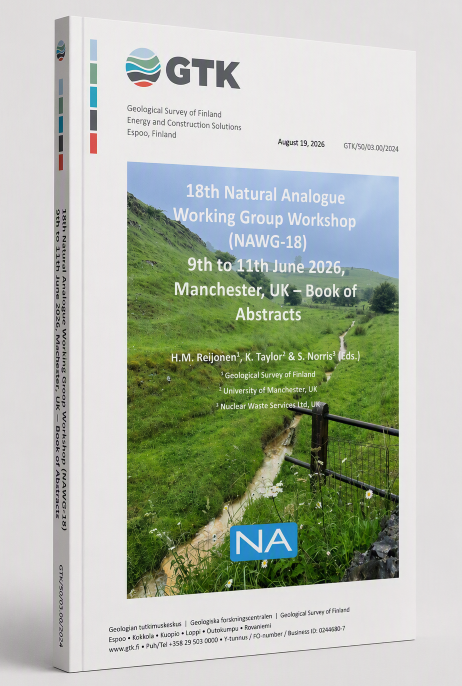
18th NAWG Workshop (Tuesday, 9th to Thursday, 11th June, 2026, Manchester, UK) FULL DRAFT PROGRAMME PUBLISHED

![]()
NAWG-18 venue, Department of Earth and Environmental Sciences, The University of Manchester, UK
Image courtesy Department of Earth and Environmental Sciences, The University of Manchester
Workshop Programme (draft)
|
|
Sessions/Topics |
Presenter |
Session chair |
|
MONDAY June 8th |
|||
|
18:00 |
Pre-meeting meet-up |
||
|
TUESDAY June 9th |
|||
|
1. Introduction and keynote |
|||
|
9:00-9:10 |
Welcome and programme of the workshop, practical info |
Heini Reijonen, GTK Simon Norris, NWS and Kevin Taylor, University of Manchester |
Kevin Taylor |
|
9:10-09:40 |
Brief history of NAWG |
Russell Alexander |
|
|
2. NA studies in RWM projects worldwide |
|||
|
9:40-10:00 |
NWS programme – recent updates |
Simon Norris, NWS |
Kevin Taylor |
|
10:00-10:20 |
Approach to compilation of a natural analogue database for geological disposal programme |
Yusaku Takubo, NUMO |
|
|
10:20-10:50 |
Coffee/tea |
||
|
10:50-11:10 |
Natural Analogues in support of the Swiss Safety Case (NTB 24‑10) within the General Licence Application submitted in 2024 |
Raphael Wüst, Nagra |
|
|
11:10-11:30 |
A Dutch natural analogue for disposal of depleted uranium |
Erika Neeft, COVRA |
|
|
3. Studies on host rocks and migration studies |
|||
|
11:30-11:50 |
Natural outcrops for understanding variability of Jurassic lower strength sedimentary rocks in the UK |
Kevin Taylor, University of Manchester |
Simon Norris |
|
11:50-12:10 |
Endmember lithological variability of the Triassic Mercia Mudstone Group, northwest England: implications for nuclear waste disposal concepts. |
Holly Mills, University of Manchester |
|
|
12:10-13:30 |
Lunch |
||
|
13:30-13:50 |
Use of natural analogues to test the consistency of Kd values in performance assessment |
James Crawford, Kemakta Konsult AB |
|
|
13:50-14:10 |
Paleohydrogeological controls on natural tracer profiles in Northern Switzerland |
Tim Schöne, GFZ Helmholtz Centre for Geosciences |
|
|
14:10-14:30 |
Trace element study in sediment and groundwater of Paleogene Formations in Zeeland, the Netherlands |
Alwina Hoving, TNO Geological Survey of the Netherlands |
|
|
14:30-14:50 |
Simulation of iodine migration at Cigar Lake – A natural analog study |
Theresa Hennig, GFZ Helmholtz Centre for Geosciences |
|
|
14:50-15:20 |
Coffee/tea |
||
|
15:20-15:40 |
Influence of groundwater residence time on radionuclides and bentonite colloids retention at the Grimsel Test Site |
Francesca Quinto, KIT/INE |
|
|
15:40-16:00 |
Charge reversal and competitive sorption of trivalent ions on aluminosilicate surfaces: Implications for radionuclide retention in crystalline host rocks |
Bahram Hosseini Monjezi, KIT/INE |
|
|
4. EBS – Container analogues |
|||
|
16:00-16.20 |
Michigan International Copper Analogue (MICA) II project – recent advances |
Heini Reijonen, GTK |
TBD |
|
16:20-16:40 |
Steel analogues (Provisional) |
TBD |
|
|
16:40-17:00 |
TBD |
||
|
19:00- |
Dinner |
||
|
WEDNESDAY June 10th |
|||
|
5. EBS – Waste analogues |
|||
|
9:00-9:20 |
Insights into uranium behaviour mediated by indigenous bacteria across pH conditions |
Dawoon Jeong, KAERI |
Heini Reijonen |
|
9:20-9:40 |
Insights into long-term vitrified waste corrosion mechanisms learned from glasses exposed to complex natural environments |
Clare Thorpe, University of Sheffield |
|
|
9:40-10:00 |
From experiments to modelling: natural and anthropic glass analogue studies for nuclear waste confinement matrix |
Delphine Neff, CEA |
|
|
6. EBS – Clay analogues |
|||
|
10:00-10:20 |
Deep geological Kiirunavaara smectites, northern Sweden: a natural analogue of long-term stability of clay minerals |
Raphael Schneeberger (presented by Raphael Wüst), Nagra |
Erika Neeft |
|
10:20-10:50 |
Coffee/tea |
||
|
10:50-11:10 |
MORO project: insights to spatial stability and integrity of montmorillonite in crystalline fractured environments, Finland |
Heini Reijonen, GTK |
|
|
11:10-11:30 |
International Bentonite Longevity (IBL) project: an introduction and overview of Phases A and B |
Russell Alexander |
|
|
11:30-11:50 |
International Bentonite Longevity (IBL) project: The potential for bentonite erosion under river flow condition |
Ryosuke Kikutchi, University of Hokkaido |
|
|
11:50-12:10 |
International Bentonite Longevity (IBL) project: Deformation and heterogeneity & outlook for Phase C |
Heini Reijonen, GTK |
|
|
12:30-13:30 |
Lunch |
||
|
13:30-13:50 |
Multiscale microstructural controls on swelling behaviour of cemented bentonite |
Tobimaru Ishiwata, Hokkaido University |
|
|
13:50-14:10 |
International Bentonite Longevity (IBL) project: Microbial analysis of Tsukinuno mine bentonite as a natural analogue for a nuclear waste repository |
Rachel Beaver, University of Waterloo |
|
|
7. Stakeholder communications |
|||
|
14:10-14:30 |
geosafe.info European Web site: A bilingual (English and Nation State language) pedagogical website with a content managed quiz feature enabling municipalities and communities to understand what siting a DGR involves. Additionally, a restricted user area for comms between graduates, Universities, TSO's, Municipalities, Regulators and WMO's. |
Colin Wales, SITEX |
Simon Norris |
|
14:30-14:50 |
NATSTRAT the new EURAD-2 WP proposal |
Heini Reijonen, GTK |
|
|
14:50-15:20 |
Coffee/tea |
||
|
|
8. Special session on Harpur Hill – field trip site |
||
|
15:20-15:40 |
Geomicrobiological studies in a high-pH system, Harpur Hill, Derbyshire, UK |
Rebecca Snow |
Heini Reijonen |
|
15:40-16:00 |
Harpur hill geology |
Russell Alexander |
|
|
|
Closing of the workshop |
||
|
16:00-~17:00 |
Closing remarks and way forward with NAWG – publication plans |
Heini Reijonen + all |
|
|
THURSDAY June 11th |
|||
|
9:00-15:30 |
Field trip to Harpur Hill by bus* (picnic lunch) Pick-up point: Manchester Museum, Oxford Road (opposite to Williamson Building) The terrain needs good shoes (trainers or similar) and might be wet and muddy. The field often contain livestock (cows). Otherwise follow the forecast for the gear for a day out. |
||
Participation & Submissions
For any questions, please contact
Important dates
Registration deadline: May 15th 2026 (but please register as early as possible it may close earlier). There will be a cap at 30 participants on the basis 1st come 1st served.
Full paper deadline: End of July 2026